




WRYDECO Journal · Design Perspective
Editorial focus: handcrafted wood furniture, natural materials & the relationship between furniture and architecture
· · Published by WRYDECO
Most rooms begin with straight lines. Floors meet walls at right angles. Windows, doors, cabinets, rugs, sofas, and shelving often follow rectangular geometry. That order gives architecture clarity, but it can also make a room feel visually repetitive when every object follows the same grid.
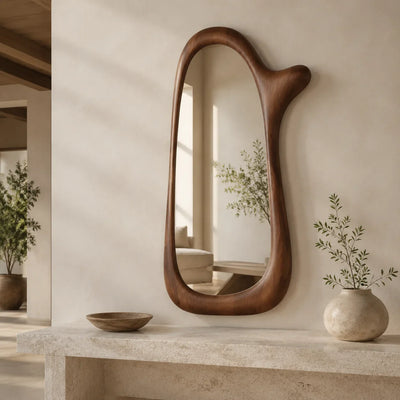
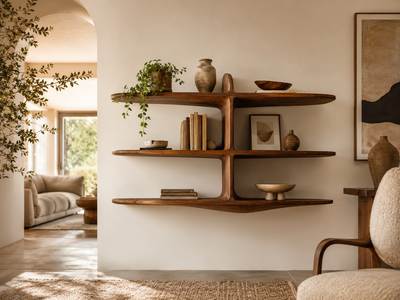
Organic-shaped furniture introduces a different kind of geometry. Curves, asymmetry, irregular edges, and changing proportions create movement without requiring the entire room to become decorative. A sculptural wood coffee table, a branching bookshelf, or a softly shaped timber base can interrupt rigid repetition while still feeling grounded in the architecture around it.
The value of organic furniture is not simply that it looks unusual. Its strongest role is relational: it changes how straight lines, open wall area, natural materials, light, and negative space are experienced together.

Design Thesis
A room can feel more natural without trying to imitate nature. What matters is allowing order and irregularity to coexist.
01 · Architectural Order
Most rooms begin with straight lines
Rectilinear architecture is useful because it creates order. Walls establish boundaries, windows organize views, flooring creates direction, and conventional furniture often reinforces those same horizontal and vertical relationships. A calm room does not need to reject that structure.
Organic-shaped furniture becomes powerful precisely because the framework around it is more regular. A sculptural table reads more clearly against a quiet rug. A branch-shaped bookshelf is easier to understand against an uninterrupted wall. The contrast allows the eye to recognize the difference between architectural order and furniture that introduces movement.
This is why an organic interior does not need curved walls, round windows, irregular rugs, and sculptural objects everywhere. The straight lines are not a problem to remove; they are the visual framework that gives the expressive form something to work against.

02 · Visual Movement
Curves change the way the eye moves through a room
A straight edge gives the eye a clear direction and a clear stopping point. A changing contour behaves differently. The eye can follow a curve around a tabletop, across a sculpted base, or upward along a branching structure before returning to the room around it.
That movement can make a room feel less static without making it visually busy. The most effective curves are usually not decorative lines added to a conventional shape. They affect the silhouette, the way the object occupies floor or wall area, and the shadows that appear as daylight moves across the surface.
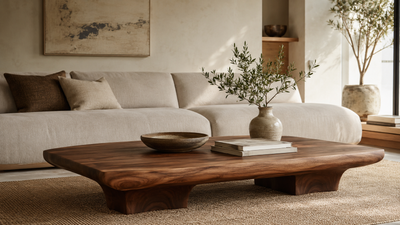
A sculptural wood coffee table demonstrates this clearly. Its outer edge may widen, narrow, or change direction as it relates to the sofa and circulation path. The form still needs to function as a table, but the eye experiences it as more than a rectangle placed in the center of a seating group.

03 · Balance Without Mirroring
Asymmetry can feel balanced without being symmetrical
Symmetry is one way to create visual stability, but it is not the only one. Organic furniture often depends on controlled imbalance: one side may extend farther, one section may carry more visual mass, or openings may vary in size rather than repeating evenly.
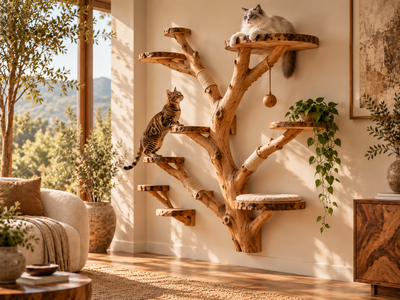
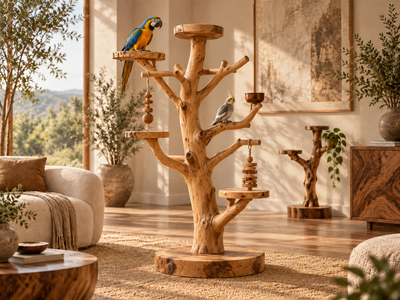
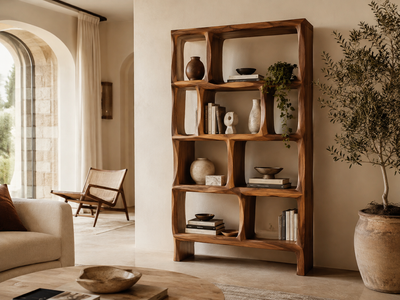
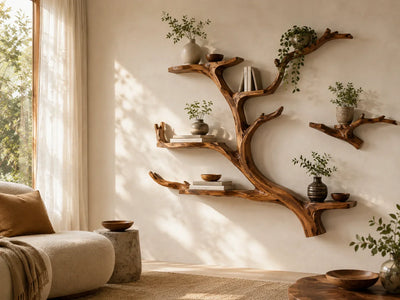
A tree bookshelf is a useful example. A longer branch on one side does not need an identical branch on the other. Balance can come from a heavier trunk, a shorter shelf placed higher, a larger open area, or the relationship between the bookshelf and nearby furniture. What matters is the total composition rather than a mirrored outline.
This approach also makes organic furniture feel less diagrammatic. The structure can remain clear and functional while avoiding the sense that every dimension was repeated only to satisfy a grid.

04 · Material Character
Natural wood makes organic form more believable
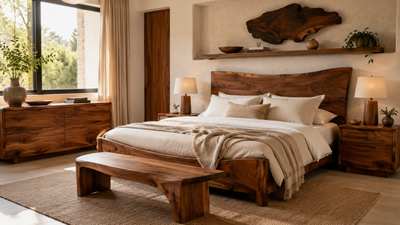
Organic geometry becomes more convincing when the material has its own variation. Natural wood brings grain direction, tonal shifts, end grain, and subtle changes across a surface. Those characteristics prevent a curved object from reading as a perfectly uniform graphic shape.
Grain can also reinforce movement. On a sculpted edge, the lines of the material may continue through a curve or reveal how a solid section changes direction. On branching furniture, the relationship between grain and form can help the eye understand where visual weight sits and how one component transitions into another.
The goal is not to exaggerate knots, cracks, or rustic texture. A refined surface can still feel natural. What matters is allowing enough material character to remain visible that the form feels shaped from wood rather than merely coated to resemble it.

05 · Space Around the Object
Negative space is part of the furniture
Organic furniture depends more heavily on the space around it than a simple rectangular object often does. If an irregular coffee table is crowded by seating on every side, its contour becomes difficult to read. If a branch bookshelf is filled edge to edge with books and objects, the openings between branches stop contributing to the silhouette.
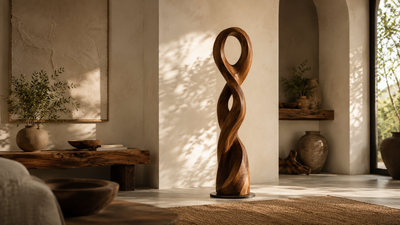
Empty wall, visible floor, and open shelf area are therefore not leftover space. They help reveal how the furniture occupies the room. This is especially important with sculptural wood furniture because much of its character comes from the relationship between solid mass and the voids around it.
The practical implication is simple: before adding more furniture or decor, step back and ask whether the organic form can still be read from across the room.

06 · Restraint
One organic piece can be enough
A common mistake is assuming that an organic interior requires every object to use curves. A curved sofa, irregular rug, round mirror, sculptural table, arched shelving, and organic lighting can quickly turn a design idea into a theme.
Often one or two expressive forms are enough. A rectangular sofa and quiet rug can create an effective setting for a sculptural coffee table. A simple reading chair beside a plain wall can leave enough visual space for a tree bookshelf to become the main vertical gesture.
Restraint also helps natural wood remain important. When the room contains fewer competing shapes, grain, edge transitions, and proportion can carry more of the visual character without relying on additional decoration.
07 · Material & Architectural Contrast
Organic furniture works best when the room gives it something to contrast with
Warm plaster provides a quiet continuous surface against which irregular wood silhouettes can remain clear. Stone introduces a denser mineral texture that can make timber feel warmer by comparison. Linen and wool soften the room without repeating the wood grain, while large windows and historic moldings create strong regular geometry that can make a sculptural piece feel more deliberate.
This is one reason organic-shaped furniture can work outside an explicitly organic-modern interior. In a quiet Scandinavian interior, the contrast may come from restrained geometry and pale surfaces. In a historic brownstone, it may come from moldings, fireplaces, and tall windows.
The important question is not whether the room already contains organic shapes. It is whether the surrounding architecture is calm enough for the new form to have a clear role.
08 · Where Restraint Matters
When organic furniture becomes too much
Organic form becomes less effective when every object tries to become the focal point. Too many irregular silhouettes can remove the contrast that made each one interesting. The room may begin to feel restless because there is no quieter geometry left to stabilize the composition.
Scale matters as well. A large dark sculptural piece can overwhelm a compact room if there is not enough wall or floor area around it. Decorative objects can create the same problem on a smaller level when they cover the very edges, openings, and grain that define the furniture.
A room feels more natural not because every object imitates nature, but because order and irregularity are allowed to coexist. Some elements provide structure. Others introduce movement. The strongest interiors make that difference easy to see.
WRYDECO Perspective
Furniture can sit between material and architecture
At WRYDECO, sculptural wood furniture is most convincing when it remains connected to the room around it. A branch bookshelf may be expressive, but it still needs a believable relationship with the wall, floor, books, and circulation. A sculptural coffee table may have an irregular silhouette, but its height, footprint, and distance from seating still determine whether it belongs in the space.
This relationship becomes especially important with live edge and sculptural wood coffee tables, where the difference between material-led and form-led design can change how strongly a piece shapes the room.
In projects where standard proportions do not resolve the relationship well, custom wood furniture designed around a specific space can make the connection between object and architecture more deliberate.

Related Reading
Explore the idea through specific spaces and furniture types
See how natural wood works inside a restrained architectural palette.
Explore the contrast between historic architectural order and contemporary sculptural wood.
Compare material-led natural edges with more intentionally shaped sculptural forms.
Explore WRYDECO
Explore sculptural wood in different forms
From branching bookshelves to custom furniture shaped around a specific room, natural wood can become part of the architecture rather than simply another object placed inside it.
Questions & Answers
Frequently asked questions
What is organic-shaped furniture?
Organic-shaped furniture uses curves, irregular contours, asymmetry, or changing proportions rather than relying only on conventional rectilinear geometry. The form can be subtle or highly sculptural while still remaining functional.
Does organic furniture only work in organic modern interiors?
No. Organic-shaped furniture can work in Scandinavian, contemporary, minimal, coastal, and historic interiors when its scale, material, and visual weight are balanced with the surrounding architecture.
Should all furniture in a room have curved shapes?
Usually not. One expressive organic piece can have more visual impact when it is surrounded by quieter furniture and regular architectural lines.
Can organic-shaped furniture work in a small room?
Yes, provided the piece respects circulation and leaves enough negative space for its silhouette to remain clear. A compact organic form can soften a small room, while an oversized sculptural object can make the same room feel crowded.
Why does natural wood work well with organic furniture shapes?
Natural wood introduces grain direction, tonal variation, and visible material character. Those variations can reinforce curves and irregular silhouettes instead of making the surface read as completely uniform.
Final Thoughts
Natural does not have to mean literal
Furniture does not need to copy a tree, stone, or landscape to make a room feel more natural. The effect can come from a simpler relationship: order beside irregularity, geometry beside movement, solid material beside negative space.
Organic furniture works best when it does not try to turn the room into nature. Its role is quieter: to introduce variation, movement, and material character into an architectural framework that is usually built from straight lines.

