




WRYDECO Journal · Design Perspective
Editorial focus: proportion, material character, sculptural form & room-specific furniture design
· · Published by WRYDECO
Furniture does not look custom simply because it is unusual. A dramatic curve, a live edge, or an asymmetric silhouette can still feel generic if the proportions, grain direction, transitions, surface treatment, and relationship to the room do not support one another.
What often separates a convincing custom-looking piece from something that feels mass-produced is specificity. The dimensions appear chosen for a particular function. The wood behaves like a material rather than a printed texture. Irregularity is controlled. Joints and thickness changes feel resolved. The finish reveals rather than erases the surface. And the final object appears to belong to the architecture around it.

The Core Idea
Custom-looking furniture feels specific rather than merely decorative
Mass production depends on repeatability, which is not inherently a flaw. The visual difference appears when a piece feels as though its dimensions, structure, and details could belong almost anywhere. Furniture begins to feel more specific when the design decisions appear connected to one another and to the place where the piece will live.
Design Detail 01
Proportion is usually visible before craftsmanship is
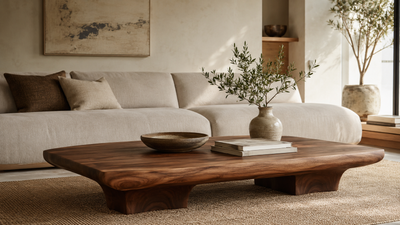
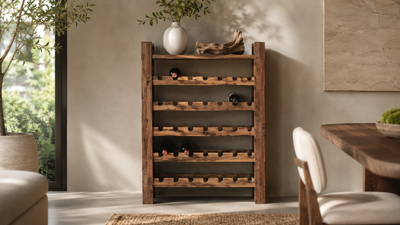
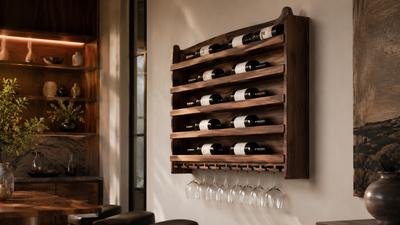
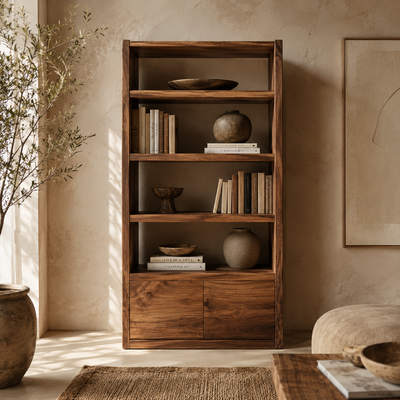
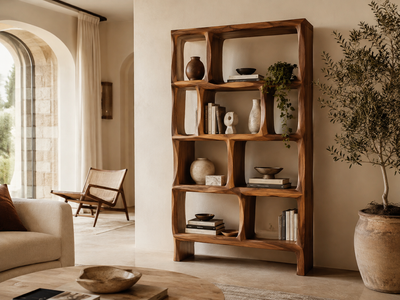
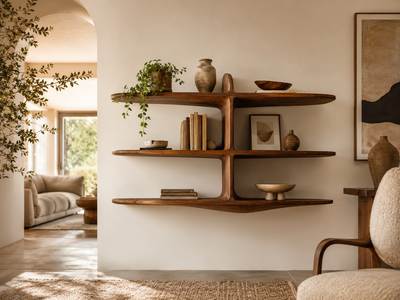
Before the eye notices joinery or finish, it reads height, width, thickness, spacing, and visual mass. A coffee table can feel generic if its top, base, and room footprint have no clear relationship. A bookshelf can feel unresolved if every shelf repeats the same span even though the overall silhouette is meant to feel organic.
Specific proportions create hierarchy. Some elements can carry more mass. Others can become lighter. Shelf spacing can respond to use. A sculptural form can be expressive without losing the practical dimensions that make it believable as furniture.

Design Detail 02
Grain should support the form, not sit on top of it like decoration
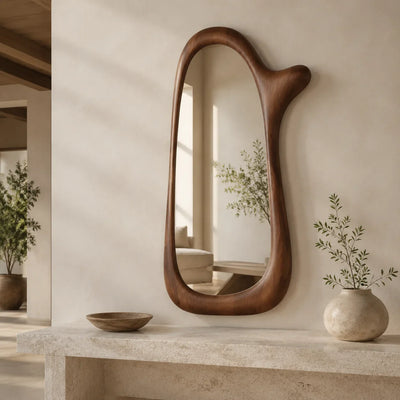
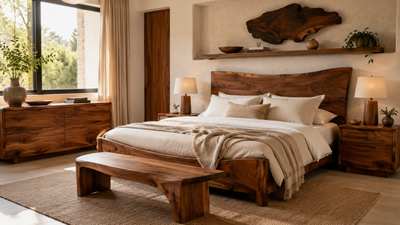
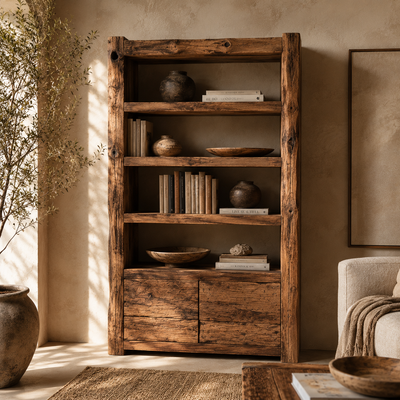
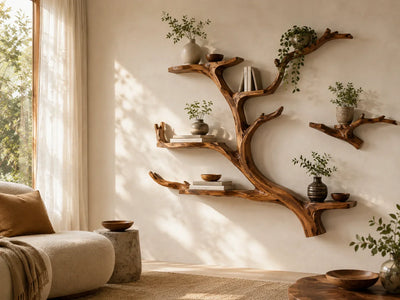
Natural wood is directional. Grain, tonal shifts, knots, and local variation create movement across the surface. On a large tabletop or a branching bookshelf, the way those characteristics meet curves, edges, and joints can either strengthen the form or make the surface feel visually disconnected.
A convincing piece does not need perfect grain. It needs the material character to feel coherent with the shape. When grain direction and silhouette reinforce each other, the furniture reads as material-led rather than as a generic object with a wood texture applied afterward.

Design Detail 03
Transitions reveal whether a sculptural form is actually resolved
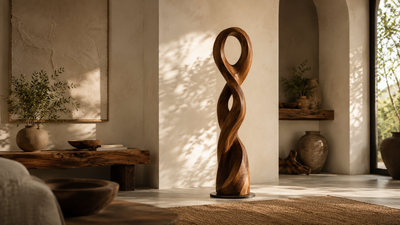
The most revealing areas are often not the large surfaces but the moments where one condition becomes another: a branch meets a trunk, a base supports a tabletop, a thick section becomes thin, or a curved edge arrives at a joint.
Abrupt or arbitrary transitions can make even an expensive material feel visually unfinished. Controlled changes in thickness, clean intersections, and believable support relationships help the eye understand how the object is built and why the form changes where it does.

Design Detail 04
Controlled asymmetry feels different from random irregularity
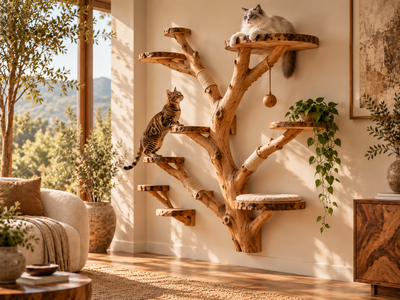
Organic furniture often uses uneven shelf lengths, off-center supports, live edges, or unequal visual mass. Those moves can make a piece feel individual, but asymmetry alone is not enough. If every element changes direction without hierarchy, the result can feel arbitrary rather than custom.
Balanced asymmetry depends on visual weight, open space, repetition, and restraint. One side may carry a longer shelf while the other holds more mass vertically. A coffee table may have an irregular perimeter while the base remains visually quiet. The irregularity works because the composition still has an internal logic.

Design Detail 05
Edges and finish determine how close the eye wants to get
Edge treatment changes the character of a piece more than it may appear to from a distance. A sharp machined edge, a softly eased edge, a preserved natural contour, and a heavily rounded profile each produce a different relationship between the object and the hand.
Finish matters for the same reason. A surface that becomes excessively uniform can hide the variation that makes natural wood visually convincing. A restrained finish can preserve grain, tonal movement, and tactile depth while still allowing the overall silhouette to remain the main idea.

Design Detail 06
The room is part of the furniture design
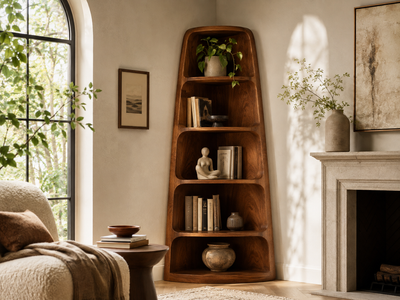
A piece can feel generic even when it is beautifully made if its scale has no relationship to the wall, sofa, circulation path, or nearby architecture. The opposite is also true: a relatively simple form can feel highly specific when its width, height, depth, and visual weight make sense in the exact room.
This is where custom sizing becomes more than a specification. It can influence whether the object reads as freestanding decoration or as part of the architecture.

A Useful Counterpoint
More irregularity does not automatically make furniture feel more handcrafted
Artificial distressing, exaggerated knots, random curves, overly rustic edges, and too many competing visual features can make a piece feel themed rather than specific. The most convincing custom-looking furniture often uses fewer gestures with greater control.
The question is not how many signs of “handmade” can be added. It is whether the proportion, material, structure, and room relationship appear to belong to the same design decision.
WRYDECO Perspective
Material, form, and architecture should reinforce one another
At WRYDECO, we are interested in furniture that can carry visible material character without becoming visually noisy. Natural grain, sculptural silhouettes, asymmetry, and custom proportion are strongest when they contribute to the same overall relationship with the room.
The goal is not to make furniture look handmade through decorative signals. It is to make the piece feel considered enough that its form, material, and placement appear difficult to separate from one another.
Related Reading
Why do organic forms change the feeling of a room?
Explore the relationship between straight architecture, curves, asymmetry, natural material, and negative space.
Read About Organic-Shaped FurnitureWhat if the room itself creates the constraint?
See how awkward walls, narrow gaps, corners, and circulation can become part of a more specific furniture solution.
Read the Awkward Wall GuideWhen does custom sizing make sense?
See how room dimensions, placement, design approval, and final use can shape a custom furniture brief.
Read the Custom Furniture GuideHow does material choice change the final character?
Compare oak, walnut, ash, maple, and other wood directions by grain, tone, finish, and visual weight.
Compare Wood CharacterExplore WRYDECO
Look for coherence, not decoration
Explore natural wood furniture where grain, proportion, sculptural form, and room placement are allowed to remain visible parts of the design.
Explore Modern Bookshelves Explore Modern Coffee TablesFrequently asked questions
What makes wood furniture look custom?
Custom-looking furniture usually feels specific in its proportions, material character, transitions, edge treatment, asymmetry, finish, and relationship to the room rather than relying on one decorative feature.
Does live edge automatically make furniture look handmade?
No. A live edge can add natural variation, but the overall piece still depends on proportion, base design, surface treatment, material coherence, and how the edge relates to the rest of the furniture.
Is asymmetrical furniture always more custom-looking?
No. Asymmetry feels convincing when visual weight, open space, repetition, and function remain balanced. Random irregularity can make a design feel less resolved rather than more individual.
Why does wood grain direction matter in furniture design?
Grain creates visual movement across the surface. When its direction supports curves, edges, and major forms, the furniture can feel more material-led and visually coherent.
When is custom sizing worth considering?
Custom sizing is useful when standard furniture repeatedly conflicts with wall proportions, circulation, sofa scale, windows, doorways, or the functional role the piece needs to perform.
Final Thoughts
Specificity is more convincing than spectacle
Wood furniture feels more custom when the visible decisions belong together. Proportion supports function. Grain supports form. Transitions explain structure. Asymmetry remains balanced. Edge treatment and finish preserve the material. And the final scale makes sense in the room.
The result does not need to be dramatic. Often the strongest sign of a considered piece is that it feels difficult to imagine with different proportions, a different material, or in a completely unrelated space.

