


WRYDECO Journal · Editorial Note
Editorial focus: handcrafted wood furniture & natural-material interiors
· · Published by WRYDECO
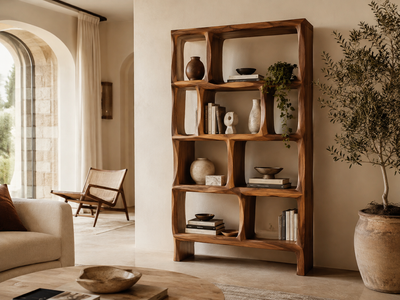
A tree bookshelf can function as storage, architecture, and sculptural furniture at the same time. That makes choosing one more involved than simply finding a bookcase that fits against an empty wall.
The right piece should relate to the height and width of the room, leave enough circulation around it, provide useful shelf space, and carry enough visual presence to justify its organic form. This guide explains how to choose a tree bookshelf for your home by looking at size, type, wood character, placement, styling, and custom-fit considerations.
Before You Choose
Four decisions to make before choosing a tree bookshelf
Use these as a quick pre-purchase check before comparing individual designs.
Check available height, width, depth, base footprint, and circulation before choosing the design.
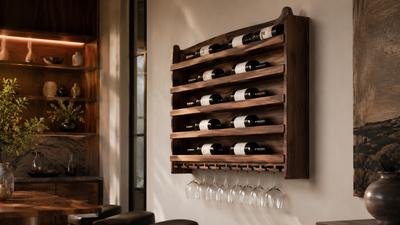
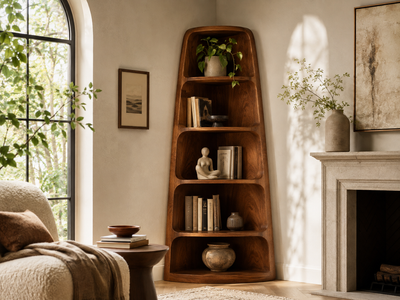
Freestanding, wall-mounted, and corner designs solve different space and installation problems.
Larger rooms can support stronger branching forms, while compact rooms usually benefit from controlled depth.
A sculptural bookshelf needs enough negative space around it to remain readable as furniture and form.
Start by measuring the room, not the bookshelf
Before choosing a design, measure the actual area where the bookshelf may live. Do not rely only on wall width. A tree bookshelf has branches, shelves, a base, and a visual silhouette that may extend differently from a conventional rectangular bookcase.
Record the available height, usable width, maximum acceptable depth, nearby doors and windows, baseboards, outlets, and the walking path in front of the piece.


Choose the tree bookshelf type that suits the room
Different tree bookshelf structures solve different spatial problems. The best option depends on floor area, wall availability, installation requirements, and how strongly you want the piece to shape the room.
| Type | Best for | Consider |
|---|---|---|
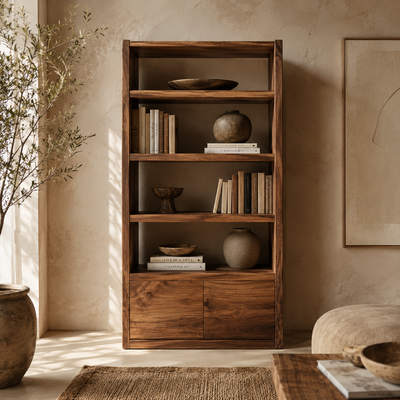
| Freestanding | Feature walls and larger rooms | Floor footprint and stability |
| Wall-mounted | Smaller rooms and visually lighter layouts | Wall construction and installation |
| Corner | Using otherwise quiet corner space | Accurate corner dimensions and shelf reach |

Choose wood for character as well as color
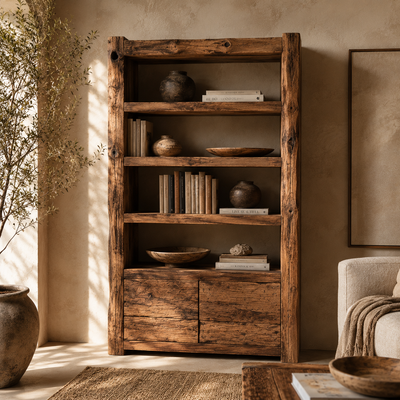
In a tree bookshelf, the wood is not merely a surface finish. Grain direction, knots, tonal variation, curves, and natural irregularities can become part of the structure and visual identity of the piece.

Where should a tree bookshelf go?
A tree bookshelf works best where its silhouette can be seen rather than squeezed between unrelated furniture. Look for a wall, corner, reading zone, office, or transition area where the piece can provide both storage and a visual focal point.
Keep door swings, window access, heating sources, outlets, and walking paths in mind. A bookshelf that technically fits but interrupts daily movement is not the right size for the room.

Decide what the shelves actually need to hold
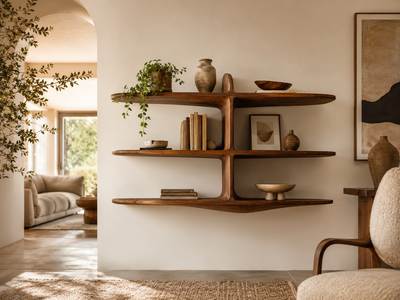
A bookshelf filled exclusively with books may need different shelf spacing and usable surface area from a display piece intended for ceramics, plants, framed objects, or a combination of storage and decoration.
Avoid filling every branch and shelf. Leaving some open space helps the tree structure remain visible and makes the objects you do display feel more intentional.

When custom sizing makes more sense
Standard dimensions are convenient when the room is flexible. Custom sizing becomes more valuable when the bookshelf must relate closely to a specific wall, high ceiling, corner, window, fireplace, desk, or architectural feature.
The goal is not simply to make the furniture larger or smaller. Proportions, branch positions, shelf spacing, base footprint, and overall silhouette should continue to feel balanced after the dimensions change.

Buying Checklist
Common mistakes to avoid before choosing a tree bookshelf
WRYDECO Perspective
Fit the bookshelf to the room, not the room to the bookshelf
A tree bookshelf is most successful when its proportions feel connected to the architecture around it. Height, branch spread, shelf rhythm, wood tone, and floor footprint should work together rather than being chosen as separate specifications.
For spaces that require a closer fit, custom dimensions can help the piece feel intentional from the beginning instead of appearing as furniture added after the room was already complete.
Explore WRYDECO
Find a bookshelf shaped for more than storage
Explore handcrafted wooden bookshelves designed around natural form, sculptural presence, and interiors that deserve more than a conventional rectangular bookcase.
Explore Modern BookshelvesFrequently asked questions
How do I choose the right size tree bookshelf?
Measure available height, width, depth, floor footprint, nearby openings, and circulation. The bookshelf should have enough presence for the wall without interfering with everyday movement.
Is a freestanding or wall-mounted tree bookshelf better?
Freestanding designs can create stronger sculptural presence and work well on feature walls. Wall-mounted designs can reduce floor footprint, but installation and wall construction become more important.
Where should I place a tree bookshelf?
Feature walls, reading areas, offices, living rooms, and unused corners can all work well when the bookshelf remains clear of doors, windows, heat sources, and important circulation paths.
Should every shelf be filled with books?
Not necessarily. Combining books with restrained objects and some empty shelf space helps preserve the sculptural branch structure and keeps the composition visually balanced.
When should I consider a custom tree bookshelf?
Custom sizing is especially useful when the piece needs to relate closely to a specific wall, ceiling height, corner, window, fireplace, desk, or other architectural constraint.
Final Thoughts
Choose the room first, then choose the tree
A tree bookshelf should not be chosen by silhouette alone. Start with the room, understand the available dimensions and circulation, decide what the shelves need to hold, and then choose a structure with the right proportion and material character.
When size, placement, wood, and shelf use work together, the bookshelf becomes more than storage. It becomes part of the architecture of the room.


